 |
| Krept and Konan, dressed as rappers who want to produce good music. |
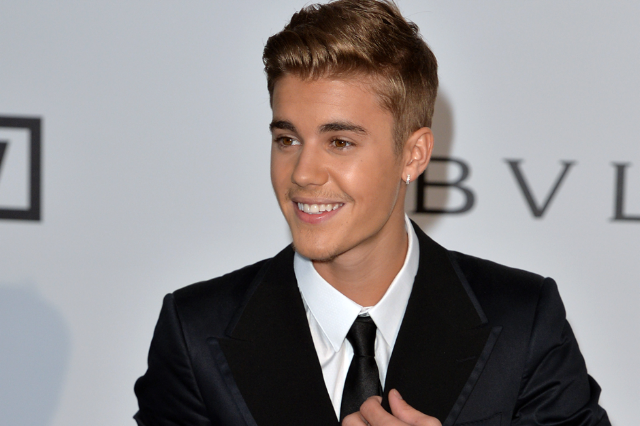 |
Justin Bieber, evidently has a target audience of teenage girls.
|
He also claims that consumers prefer artists that aren't constructed by the record labels who try to create fake/artificial images for them. It is much better when artists portray that they're true to themselves as the audience can identify with them. A "real" artist can use this as their unique selling point. An example of this is Ed Sheeran, who is not image focused.
Promotion - Ideology & Culture
Another one of Dyers beliefs in Star Theory is that artists become trendsetters in the sense that audience members will imitate their hairstyles, clothing, lifestyle choices etc. An example of a lifestyle that the artist has that may be followed by fans is religious beliefs and cultural values. Due to the rapid development of the internet and the proliferation of hardware has meant that audiences have greater and quicker access into the personal lives of these stars. Social networking sites such a Twitter have been used to create fan pages that follow and promote the stars' day to day life as wel a music.
Stars support hegemony
Artists support the ideas of hegemony, propounded by Gramsci, in which highlights how society uses cultural institutions to maintain power in capitalist societies. They are presented as the more extravagant and wealthier versions of everyday humans.
Representation in music videos
Music videos can be used to send out specific messages regarding racial and gender identities. American hip-hop artist Chris Brown conforms to the stereotypical African-American rap which has a strong focus being "rich" and having an abundance of material things such as sports cars along with having sex with plenty of women. His song "Ayo" conforms to this racial stereotype and gives the audience something to look up to
.
 |
| Chris taking a photograph with money in his hand to display his wealth, along with many notes being dumped into his pool. This strengthens the notion that he is extremely wealthy as he can afford to destroy money. |
 |
| Here is surrounded by sports cars and many attractive women sitting on them. This shows that wealth allows you to have all the beautiful women you could ever want, also this conforms to the typical African-American rap video stereotype where there is a strong focus on the female as a sexual object and materialism. |
 |
| Tyga and Chris Brown wearing expensive jewellery to show how wealthy they are and conforming once again to the black rapper image. |
Deconstructing Britney Spears (1998)
.jpg)
Britney Spears raises interesting concerns regarding female identity in pop music Spears was initially viewed as a role model for the teen girl market. From a gender perspective Britney's identity was positioned securely in a male-dominated industry that works on the stereotypes of femininity.
Early videos:
In her earlier videos we can see that she was surrounded by particularly "girlie" mise-en-scene such as bedroom culture, dolls, dressing up with friends, hanging out and applying make up.
Here she has her hair in pigtails - showing her youth along with choreographed dance routines.
Although this music video may appear to have an innocent message to it with a young girl jsust having fun with her friends but it is very exploiting. Laura Mulvey's male gaze is evident at certain parts during the video with Britney Spears used as the object of desire by wearing a low cut top and skirt. Additionally, her dance routine is very sexual along with the lyrics, "hit me baby one more time" which indicate the desire for penetration. This contrasts the "girlie" image that is being shown on the surface. Despite her taking up the active role in the video, the audience is forced to indentify her through the male gaze. Mulvey's theory displays how music videos can portray a patriarchal society as well as films.
On the other hand, Britney does have songs which show her teen identity by the year 2000 in which she is seen in a different way than before. We notice that her image changes wit her audience therefore her image changes all the time.
"From The Bottom Of My Broken Heart" reflects Britney's own troubles that she faces when entering adulthood after beng a teenager, in which many of her fans could relate to.
In 2001, a year later, Britney releases "I'm Not A Girl, Not Yet A Woman" from the film "Crossroads", here she is constructed as a role model. The video delves into the journey of growing up from a girl into a woman. However, she still maintains the male gaze to become a part of male erotic desire.
1) Shows Britney as a girl wearing white to represent purity, innocence and youth. No revealing clothing is worn here which would allow her to be seen in a sexual manner.

2) Britney has now become a woman and is seen wearing white again, however due to the low cut top and shorts, plenty of her flesh is on display causing the male gaze to take place and her to fall under the desire of men. Additionally her body language is very vulnerable and sexualised indicating she is ready to be subjugated by a man.

Moreover, "Overprotected" (2002) is a song that is empowering to women as its message refers to Britney no longer liked being told what to wear as if she's still a child. This video was a direct response on a news report about the attire she wears, and felt that this was an act of empowerment because she has the right to feel comfortable with her body.
Modern Britney
Britney's career has evolved from once being a so called "Teen Princess" to a half naked woman who performs for a male audience. Both of these identities are stereotypical illusions of femininity as presented in a range of media texts. The effect of these evolving images is shown to have on Britney in her videos, in particular: "Hold It Against Me" (2011). In this video she rises up on a platform in a long white dress, which could represent that this is the 'new' and 'fresh' version of her. As she begins to rise above the screen this can indicate that she is bigger and better than the media and doesn't need their approval of her. Around 2/3 of the way into the video a duplicate Britney appears and she begins to fight her, signifying that she doesn't want the old Britney that could be recognised earlier in her career, to interfere with the new and improved version of herself. In conjunction to that, during their fight the several screens surrounding them playing Britney's old videos such as "Hit Me Baby One More Time" start to turn off as Britney punches her old self.

No comments:
Post a Comment